
A mobile shop is not a normal retail shop. The same counter sells one phone worth Rs 60,000 and thirty covers worth Rs 250 each — in the same hour. And every phone sale opens a story: which IMEI left the counter, against which supplier's invoice, with whose warranty card? That is exactly why POS software for mobile shop owners has to be built differently. MrPOS is a Pakistani POS software company for retail and restaurants; in this guide we break down what mobile and accessories shops need in 2026 — features, costs in PKR, and a usable checklist.
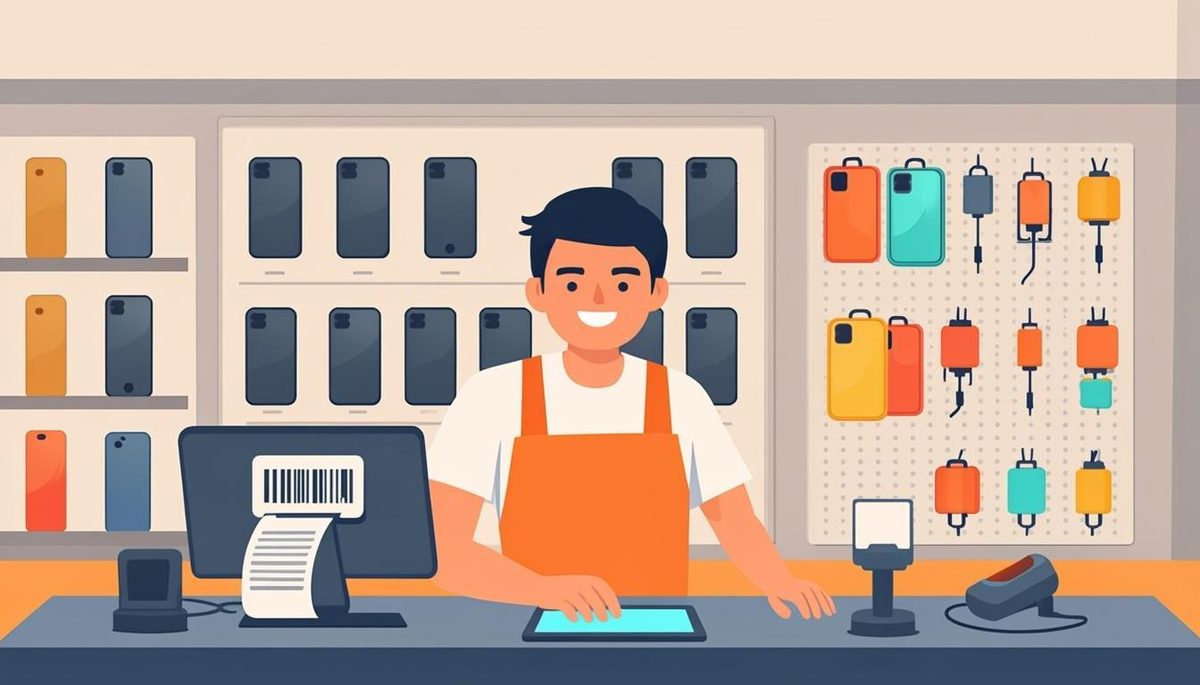
Why mobile shops need different POS software
A garments shop sells a shirt: bill it, it leaves, done. A mobile shop sells a phone — and the story only starts at billing. Which IMEI left the counter? Against which supplier's invoice? With how much warranty? Two weeks later the customer is back with a fault and you are searching a register at 9pm.
Then there are the accessories: covers, chargers, cables, tempered glass, earphones, power banks — hundreds of small SKUs, fast-moving and easy to lose count of. The market itself is huge: PTA counted about 196 million cellular subscriptions in late 2025 (PTA Telecom Indicators), and every one of those phones eventually needs a cover, a charger or a repair. The shop that cannot tell its stock apart is guessing at its own profit.
POS software for mobile shop owners: the feature checklist
These are the features that separate a real mobile-shop system from a generic billing app:
- IMEI / serial tracking — every phone enters and leaves with its IMEI or serial recorded; warranty claims and exchanges take seconds.
- Model-wise price lists — wholesale vs retail rates, and old-model price drops the moment new stock lands.
- Color and variant handling — one cover, four colors: billed separately, counted together.
- Repair job tracking — screen change, software flash, battery swap: each job gets a token, a status and a delivery date.
- Supplier ledger — the mobile market runs on wholesale credit; track what you owe whom and when it is due.
- Warranty records — attached to the IMEI, not to a paper card the customer will lose.
MrPOS Retail ships all of the above — plus built-in accounting, because sales reports without expenses are half a picture (full set on the MrPOS Retail product page).
IMEI, serials and the battery problem
Batteries age in the box: a power bank loses life sitting on your shelf, so old stock quietly becomes discounted stock. If you cannot see purchase dates, you sell the new one first and eat the loss on the old. Good POS software gives you batch and aging views, so old batteries and slow-moving models get sold before they lose their value.
The scale of the trade makes this worth doing properly. Pakistan imported mobile phones worth $1.889 billion in FY2025-26 — up 26.6% from $1.492 billion the year before (Pakistan Bureau of Statistics). Every handset without an IMEI record is stock you are tracking from memory.
Billing speed: covers, chargers and cables
Accessories are a volume game. Evening rush at a mobile counter looks like a fast-food queue: a cover, a glass, two cables — each customer out in under a minute. This is where a touch billing screen with quick keys and a barcode scanner earns its keep: tap, scan, print, next. Globally the pull is the same — Grand View Research projects the mobile accessories market to reach about $189.9 billion by 2033, growing at roughly 7.8% a year from 2026. More volume per counter is exactly why billing speed decides the queue.
Udhaar, WhatsApp and the repeat customer
Every mobile shop owner knows the customers who "bhi de denge kal" — the udhaar list. A paper khata forgets; POS software does not. Each credit sale attaches to a name, number, running balance and due date — and a polite, automatic WhatsApp reminder goes out when payment is late.
The same customer list powers the second half of the business: follow-up. New model launch aya? A message to everyone who bought that brand last year. Warranty about to expire? A service reminder. The shops that grow are the ones that call the customer first — the POS keeps the list.
What does POS software cost for a mobile shop in Pakistan?
Three cost models, same as any retail trade:
- Cloud subscription — the standard: roughly Rs 2,500–10,000 per month depending on features and branches, with support and updates included.
- One-time license — pay once, run offline; suits single-counter shops.
- Hardware — a basic counter (computer or touchscreen, barcode scanner, receipt printer, cash drawer) starts around Rs 40,000; much of it you may already own.
Compare that to the leaks it stops: one phone sold on forgotten udhaar, one battery sold at a wrong price, one box-piece that "adjusted" itself — and the month's subscription is paid for.
"A mobile shop sells the same cover in four colors and the same charger under three brand names — if your POS cannot tell them apart at billing speed, your stock count is fiction." — Talha Habib, founder, MrPOS
How to choose: the owner's 7-point checklist
- IMEI tracking built-in — not an add-on module you pay extra for later.
- Repair tickets included — if you do hardware or software servicing, keep it in the same system.
- Supplier ledgers — because the wholesale market runs on credit.
- Urdu or Roman Urdu interface — your counter staff should learn it in a day, not a month.
- Data import from Excel — your opening stock and khata move in free, with help.
- WhatsApp on the same platform — reminders and marketing without a second tool.
- FBR-readiness — if turnover crosses the Tier-1 threshold, integrated invoicing becomes a legal need; ask the vendor now (see our FBR POS integration guide).
Frequently asked questions
What is the best POS software for a mobile shop in Pakistan?
Look for a system built for the trade: IMEI/serial tracking, variant billing, repair tickets, supplier ledgers and Urdu-friendly staff screens. MrPOS Retail covers all of these with local WhatsApp support — test it on your own data with a free demo.
Do I really need IMEI tracking in my POS software?
Yes — warranty claims (prove the unit and its purchase date), exchanges (match the returned unit to the sold one), and theft checks (confirm whether a suspicious IMEI passed through your counter). Without IMEI records, a phone is just one black box on a shelf.
Can POS software handle mobile phone repairs too?
Good ones can. Each repair becomes a job with a token, customer contact, reported fault and status — received, in progress, ready, delivered. Parts used are deducted from the same inventory; repair income lands in the same daily profit report.
How much does POS software cost for a mobile shop?
In Pakistan, cloud POS for a single-counter mobile shop typically runs Rs 2,500–10,000 per month including support. Basic hardware starts around Rs 40,000 if you do not already own it; one-time offline licenses also exist.
Can the system track PTA-approved and non-PTA phones separately?
Yes — use product tags or custom fields. Mark each phone's PTA status at purchase and the stock report separates them automatically, keeping compliance paperwork simple.
Next step: see your own shop inside a POS
Reading is step one. Step two is watching your own models, covers and udhaar list move inside a live system. MrPOS offers a free live demo (no card required) — setup typically completes in one day, including your stock import. WhatsApp us at 0316 6132742 or message us for a free demo.
Explore the products: MrPOS Retail · MrPOS ERP · MrPOS RMS — or read our full cost breakdown for Pakistani shops.